
How Medina County Most Wanted Works
Medina Municipal Court runs the county's only official Most Wanted resource. It covers people wanted on matters pending in that court. The program publishes monthly posters and keeps an archive of older ones. The scope is narrower than the name suggests. This is a Municipal Court effort, not an MCSO countywide list. It is not a complete index of every warrant issued in Medina County.
There is no verified count of current listings. No fixed schedule and no reward program exist either. Posters carry dates, so a dated poster is a historical document rather than a live roster. Go straight to the court's page for current information. Check the date printed on any poster you find. Someone can have an open court matter yet never appear on the poster, and any entry still needs verification through a court record before you draw conclusions.
Fields on Medina Municipal Court Wanted Posters
The poster format serves a public-safety message. It is not a census of local warrants. One July 2023 edition named people who had failed to appear. Each entry was tied to a local law-enforcement agency. To see whether the format has changed, use the live court page rather than a saved image or a copied listing.
| Field or notice | What it communicates |
|---|---|
| Name and identifying presentation | Helps the public recognize the person named by the Municipal Court poster; it is not a substitute for identity confirmation. |
| Failure-to-appear context | Explains the court-process reason described on the historical poster, rather than a final finding on the underlying charge. |
| Local law-enforcement agency | Shows the agency associated with the listed warrant matter in the poster format. |
| Poster date or archive placement | Shows that the material is time-specific. It does not certify a current warrant status. |
| Safety and tip instructions | Directs the reader to law enforcement and warns against attempting detention. |
A poster may leave out a charge, an address, or a caution note. That silence means nothing. The Municipal Court notice is deliberately limited. A court case file or a warrant inquiry carries different fields, different access rules, and different timing.
Use Medina County Most Wanted Safely
A wanted poster is best used to find the right reporting channel. It is not a license to investigate or confront anyone yourself. The court's own poster warns that warrants may not yet be entered in a police computer. That caution makes any dated poster a poor do-it-yourself enforcement tool. Call the professionals instead.
- Open the official Municipal Court Most Wanted resource and check the date and court context of the item being viewed.
- Read the name and any program information without trying to resolve identity from an image or a partial match.
- If information may be useful to law enforcement, use the published warrant hotline or contact local police. Share only what is actually known.
- Do not approach, follow, confront, transport, or try to detain anyone shown on a poster.
- For a custody-related follow-up after an arrest, use the Medina County record lookup to distinguish a current jail entry from the separate court matter.
After an arrest, a jail roster can show current or recent custody. It cannot tell you whether a specific warrant is still active. And a missing roster entry never erases a court record.
Medina County Warrant Check by Court
Any real warrant check starts with the court that issued it. The two Medina County courts take separate paths. Common Pleas felony matters run through the Medina County Clerk of Courts and its linked Tyler case portal. Municipal Court matters go through the court's own case-access system. Neither portal promises that every active warrant is searchable online. Treat them as starting points.
- Identify the likely court from the known case information. A Municipal Court case and a Common Pleas felony case can have different records and numbers.
- Search the official court portal using accurate identifying information and read the docket context rather than relying on a name alone.
- If Common Pleas information is incomplete, contact the Clerk of Courts at 225 E Washington St, Medina, OH 44256, or (330) 725-9722 for the appropriate records route.
- For a Municipal Court matter, contact the court or its Bailiff’s Office for current guidance rather than relying on a historic poster or an unofficial copy.
- If the inquiry concerns the person affected by the matter, contact the issuing court or an attorney to address it lawfully. Do not attempt to avoid service or resolve it through a third-party listing.
The Clerk's published counter hours are Monday through Friday, 8:00 a.m. to 4:30 p.m. Portal results, docket entries, and warrant status can each shift at different points in a case. The issuing office always has the current answer.
Common Pleas and Municipal Warrant Types
The two courts split the work. Medina County's Clerk of Courts handles the felony side: filing, docketing, indexing, and preserving records. The clerk also issues warrants in that role. Municipal Court manages its own cases and runs the Most Wanted program you see here. One person can appear in one system and never show in the other. When it matters, check both.
| Record path | Typical role in a warrant inquiry | Official starting point |
|---|---|---|
| Medina Municipal Court | Municipal-court matters and the court’s public Most Wanted program, including failure-to-appear context shown on historical posters. | Municipal case access |
| Medina County Common Pleas | Felony criminal dockets and warrants in the Clerk’s court role. | Clerk of Courts and the Tyler portal |
| County jail custody | Can show a person is in current or recent adult county custody after an arrest, but does not replace the issuing court’s warrant status. | MCSO CentralSquare roster |
"Wanted," "warrant issued," "failed to appear," "arrested," and "case resolved" mark different stages of a matter. They are not interchangeable. For later actions, look to the court docket instead. That is where hearings, dismissals, pleas, sentences, and other outcomes appear.
Tips for Medina Municipal Court Bailiff
The court's Bailiff's Office lists warrant enforcement among its duties. It also runs a dedicated warrant hotline. The official poster says phoned-in tips stay confidential. No reward program or dollar amount appears anywhere in county materials. Don't count on Crime Stoppers money here.
Warrant hotline: (330) 722-5870
Municipal Court: 135 N Elmwood Ave, Medina, OH 44256
Court phone: (330) 723-3287
For an immediate safety emergency, contact local emergency services.
When you call, stick to facts rather than guesses. The court directs people to contact local police, and the hotline exists as the specialized channel for warrant information. If you're the one facing a warrant, a tip line is the wrong tool. The court itself or a lawyer can explain your case.
The court's Bailiff's Office source is shown below.
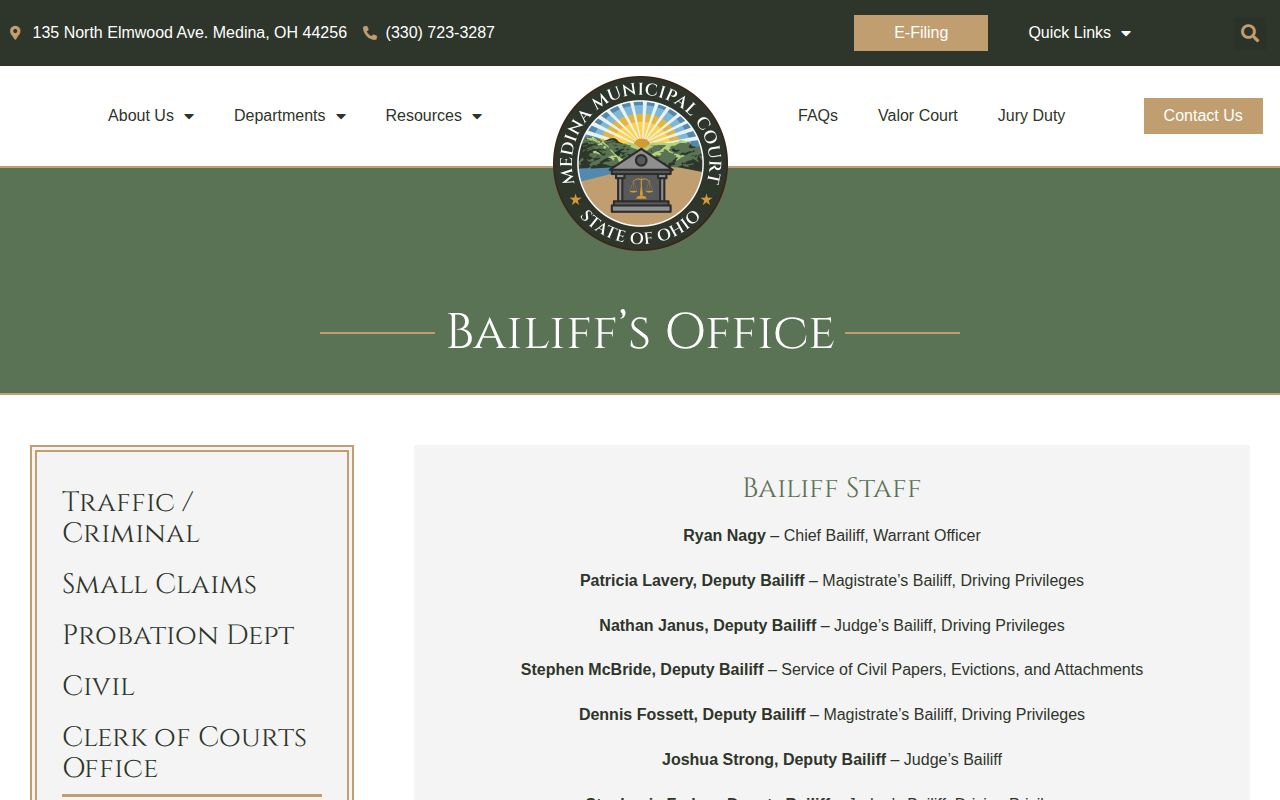
This court-office source identifies the warrant-enforcement channel and nothing more. It is not a live countywide warrant list. Confirmation still comes from the issuing court.
Medina Municipal Court Warrant Program Context
Medina Municipal Court's 2025 annual report counted 1,016 warrants resolved across 758 defendants. That figure covers one reporting period. It is not a headcount of people on the current poster. Nor is it a tally of every active warrant in Medina County, and it says nothing about how often the public list gets updated. Treat the number as a snapshot of court casework rather than a live measure of who is wanted right now.
Many of those warrants were cleared after law enforcement made contact. Some contacts came from local departments; others from agencies outside the area. That detail tells you something useful about the poster itself. The public's safest role is passing a tip through the proper channel. Confirmation and resolution belong to the court, an attorney, and law enforcement. It also explains why an archived poster can never replace a live countywide warrant search.
Medina County Services That Are Not Warrant Tools
Not every tool on the sheriff's site does what its name suggests. MCSO's public "MCSO Application" link is a staff application, not a jail app or warrant app. SmartInmate and ConnectNetwork handle correctional communication, visitation, messaging, and deposits. Neither one is a public booking feed or a warrant search. VINE services cover custody status and victim notification, not a wanted list.
These distinctions matter when a name is missing from a poster or roster. CentralSquare works for current or recent adult county custody only. Court systems are the right place for case and warrant inquiry. For a safety-related tip, call the hotline or local police.
Medina County Warrant Source Limits
A poster, a docket, and a jail result each answer a different question. The Municipal Court's public program alerts residents to selected court matters. A docket records activity inside the court that keeps it. The county roster shows who is in adult custody now or was recently. Read each record for its own purpose. One empty search does not settle everything.
| Source | What it can help establish | What it cannot establish alone |
|---|---|---|
| Municipal Court Most Wanted resource | A dated public notice tied to that court’s program | A complete countywide warrant status or a current result from an old poster |
| Municipal or Common Pleas docket | Case activity and the issuing court’s procedural record | That every active warrant is fully visible in a public online search |
| MCSO CentralSquare roster | Current or recent adult county custody after an arrest | Whether a particular warrant remains active or how a court matter ended |
One old poster from the court carried a warning worth remembering: a warrant might not yet be entered in a police computer. A search result, in other words, is not a legal conclusion. Someone personally affected by a warrant should contact the issuing court or an attorney next. A member of the public with a safety tip should use the published hotline or local police. Neither route asks you to investigate, approach anyone, or act on a partial record.